
Thorpe Tube Flowmeter
A Thorpe tube flow meter (often called a rotameter, or a pea-shooter) is a device used to measure gas flow, particularly in welding, medical, and laboratory applications. It operates on the principle of variable area flow measurement. The flow rate is indicated by the position of a float in a tapered, transparent tube.
The construction of the a Thorpe tube flow meter varies by application but typically consists of:
- A vertically mounted, tapered glass or plastic tube that widens from bottom to top. This is the Thorpe tube.
- A lightweight float (usually metal, glass, or plastic) that can move freely up and down inside the tube.
- A calibrated scale along the tube, marked in units of flow (e.g., litres per minute).
- An outer glass or plastic envelope that returns the gas to the outlet at the bottom.
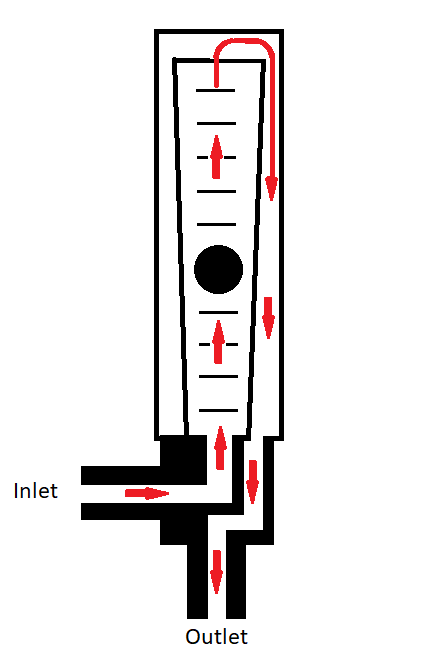
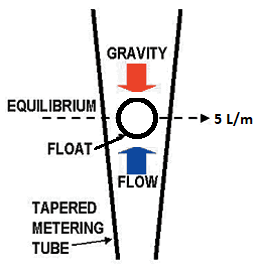
When gas enters the tube the flow exerts a upward force on the float while the weight of the float exerts a downward gravitational force.
Because the tube is tapered, the higher the float rises, the larger the cross-sectional area for the gas to flow through. This causes the gas velocity around the float to decrease resulting in less upward force.
The float rises until the upward force from the gas equals the downward force caused by the weight of the float (i.e., the forces are balanced).
At this balanced position, the float height corresponds to the flow rate, which can be read off the calibrated scale. The scale is read at the centre or top of the float, depending on the meter’s design. Instructions are often written on the side of the tube.
The scale is usually calibrated for a specific gas, pressure and temperature, since gas density affects the float’s behaviour. Flowmeters for welding often contain two scales, one for argon and another for carbon dioxide.
A Thorpe tube flow meter gives an instant visual indication of flow rate, shows a reduced flow if blockages occur and correctly indicates no flow when the flow stops.
However, it is sensitive to orientation (must be mounted vertically), is prone to damage, and has a gas-specific calibration. The reading will not be correct if used with a different gas or pressure than specified.