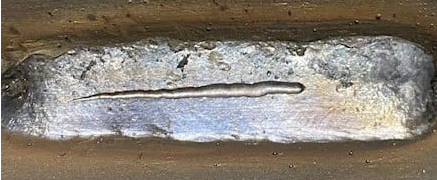
Worm Tracks are often encountered in both self-shielded and gas shielded flux core arc welding (FCAW). They are caused by gas that has come out of the solidifying weld but has been trapped under the slag.
Worm Tracks are also called:
Elongated Porosity (AWS A3.0 2010)
Gas marks
Chicken Feet
Chicken Tracks
Elongated Porosity is a form of porosity having a length greater than its width that lies approximately parallel to the weld axis. (AWS A3.0 2010)
These are not the same as Worm Holes, or more correctly, Piping Porosity. Worm Holes are also called:
Piping Porosity (AWS A3.0 2010)
Worm Hole Porosity (listed in AWS A3.0 2010 as a non-standard term)
Pin holes
Piping Porosity is a form of porosity having a length greater than its width that lies approximately perpendicular (at right angles) to the weld face. (AWS A3.0 2010)
A Worm Track that is not associated with, and does not contain other porosity, is not considered a defect unless there is a Welding Procedure Specification (WPS) that precludes it.
In the absence of a WPS that precludes it, this Worm Track would not be considered a weld defect.
What causes Worm Tracks?
It was stated above that Worm Tracks are caused by gas that has come out of the solidifying weld but has been trapped under the slag. But where does the gas come from? Usually, the gas is hydrogen that has come from moisture in the joint, the flux cored wire or, where used, the shielding gas. This is despite the use of hydrogen scavengers such as fluoride compounds, which combine with hydrogen to remove it from the weld.
Some suggest that atmospheric nitrogen also plays a part in the case of self-shielded FCAW but the wire and the weld are fairly well protected from nitrogen. The wire is protected because of the polarity of the wire and the puddle is protected by the slag.
How to Prevent Worm Tracks from Appearing
Remove The Moisture
Moisture in the weld area can be removed, or at least reduced, by making sure that:
the joint and the weld area are dry – some preheating may help.
the shielding gas, where used, is not contaminated.
the flux core wire is not contaminated.
Contaminated wire is a common cause of worm tracks and other welding problems. The flux absorbs water over time so the age of the wire and the method of storage is important. If in doubt, change the wire.
Use the Correct Technique
FCAW needs a longer electrode extension (also called electrical stickout) than MIG so that the flux is pre-heated and “activates” prior to entering the weld pool. If this does not happen, the deoxidisers, denitrifiers and hydrogen scavengers contained in the flux cannot remove all the gas in the puddle and the remnants are trapped under the slag forming “worm tracks”, and possibly more serious forms of porosity, as the puddle solidifies.
If worm tracks are observed:
Increase the stickout to properly preheat the flux, or
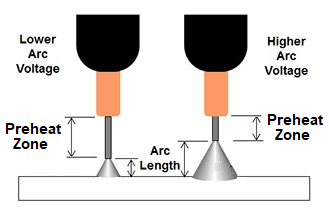
Decrease the voltage to reduce the arc length. If the standoff distance is roughly constant, the stickout will increase thereby further pre-heating the flux as required.
The effect of Voltage on the flux preheat zone. The preheat zone is equal to the electrical stickout.
In either case, it is the stickout that is important because that is where the flux is pre-heated.
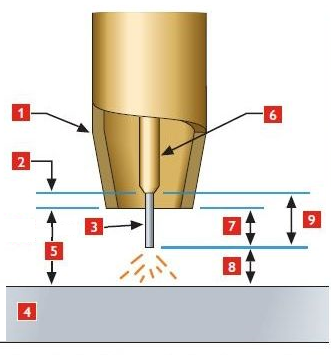
1. Gas Nozzle 2. Contact Tip Setback 3. Consumable Electrode 4. Workpiece 5. Standoff Distance 6. Contact Tip 7. Visible Stick-out 8. Arc length 9. Electrical Stick-out
Select a Different Shielding Gas
With gas shielded FCAW, worm tracks can sometimes be reduced by using a more active shielding gas. Using CO2 rather than an argon-CO2 mix means that more oxygen is available to combine with the hydrogen and help remove it from the weld.
Severe Worm Tracks
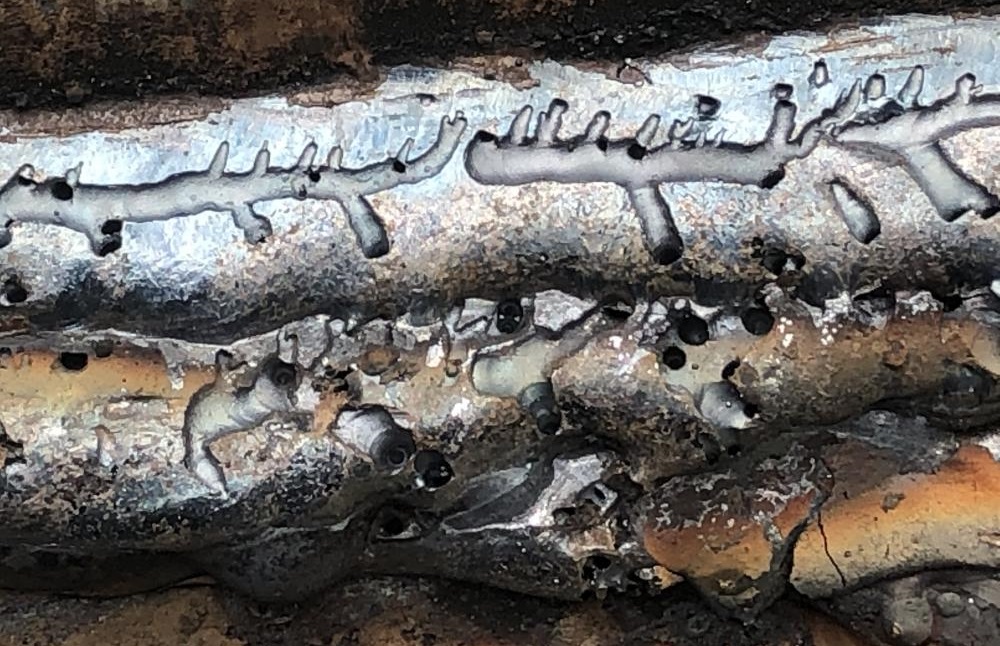
More severe worm tracks that occur in combination with piping porosity and other porosity in general are indicative of contamination that must be addressed first.
Although there are worm tracks shown here, the presence of the many pin holes suggesting piping porosity indicate a contamination problem that is beyond the scope of simple worm track mitigation. These problems should be addressed first as they are weld defects.
Summary
Worm Tracks are a
form of porosity seen in FCAW having a length greater than its width that lies
approximately parallel to the weld axis. They are not considered defects unless
there is a Welding Procedure Specification (WPS) that precludes them.
Worm Tracks are
caused by (generally) hydrogen that has come out of the solidifying weld but
has been trapped under the slag. The hydrogen comes from moisture in the joint,
the flux cored wire or, where used, the shielding gas.
Worm Tracks can be
mitigated or prevented by:
Eliminating moisture from the
weld area
Using wire that has been
stored correctly and is not contaminated by moisture
Maintaining the correct
stickout to ensure the wire is properly pre-heated
If the stickout or
the amount of active gas in the shielding gas required to remove the Worm
Tracks conflicts with the manufacturer’s recommendation, there is too much
moisture in the weld area and this should be addressed first.
Sources
AWS – A3.0 Standard Welding Terms and Definitions (2010)